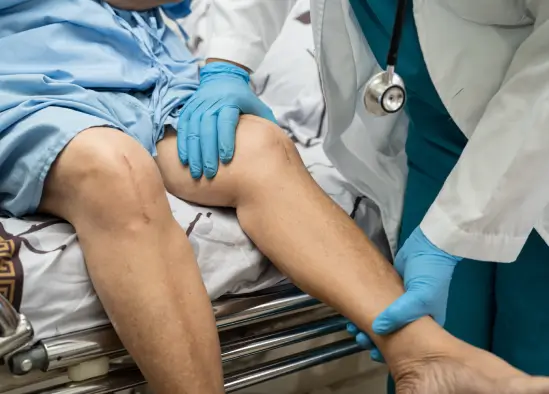
Dr. Kuldeep Malik at Max Healthcare is skilled at performing both robotic and traditional total knee replacement surgeries based on the latest evidence-based surgical practices. His surgical strategy is centred on joint balance restoration, long-term implant longevity, and patient confidence in their mobility.
Understanding Knee Joint Degeneration
The knee joint supports a tremendous amount of weight, keeping us upright and allowing us to move. Over the years, conditions such as osteoarthritis, inflammation, injury, or just the natural process of aging can weaken the protective cartilage that enables the knee to move smoothly. As this cartilage deteriorates, the joints begin to rub against each other, causing pain, inflammation, stiffness, and the subsequent changes that accompany deformity.
However, when old methods no longer provide relief, surgery becomes the most effective means of restoring function. A knee replacement surgery addresses the underlying problem, allowing patients to move freely without any pain or discomfort.
Who May Benefit from Knee Replacement Surgery?
This is a procedure for people whose lives are significantly impacted by their advanced joint damage. Many of the patients for this surgery experience pain that interferes with their daily activities.
The patients for this surgery are likely to be people who experience:
- Advanced osteoarthritis that causes joint damage and deformity
- Chronic pain that interferes with walking, standing, or climbing stairs
- Stiffness that limits the movement of the knees
- A reduced response to pain medication, physical therapy, or injections
- A progressive loss of mobility and independence
A knee replacement is more than just a pain solution; it’s a solution for restoring the function of the knee.
Advanced Treatment Approach and Surgical Precision
Dr. Kuldeep Malik’s approach is reflective and patient-focused, combining the latest technology in surgery with expert clinical knowledge. Every procedure begins with a comprehensive evaluation: imaging, functional analysis, and a close examination of the individual patient’s anatomy and lifestyle, to develop a personalised plan for the knee surgery.
Robotic-assisted knee replacement surgery offers unparalleled accuracy, controlling the positioning of the implant and aligning the knee for smooth, natural motion. Intraoperative data ensures a stable and long-lasting outcome. The practice also offers traditional knee replacement surgery with the same degree of accuracy, based on extensive experience and expertise.
The strategy is designed to achieve:
- Precise positioning and alignment of the implant
- Enhanced joint stability and smooth, natural motion
- Preservation of surrounding tissue and minimal disruption
- Longer-lasting implants
- Reliable surgical results
Types of Knee Replacement Procedures Offered
The course of surgery that is suggested depends on the severity of the joint damage and its location. There are several options:
- Total Knee Replacement (TKR): joint surface reconstruction
- Robotic-Assisted Knee Replacement: a more precise and personalised alignment
- Partial Knee Replacement: targeted surgery for single-compartment damage
- Revision Knee Replacement: repairing a failed joint replacement
Each treatment is tailored to achieve the best possible functionality while preserving as much of the original anatomy as possible.
Benefits of Knee Replacement Surgery
Knee replacement surgery offers rapid pain relief and long-term functional improvement. Following the healing process, patients experience:
- A significant reduction in chronic pain or complete pain relief
- Improved mobility, flexibility, and stability of joints
- Correction of misalignment and realignment of any deformity
- Ease in performing daily tasks without pain
- Regained independence and confidence in movement
Finally, the surgery enables patients to lead an active and fulfilling life.