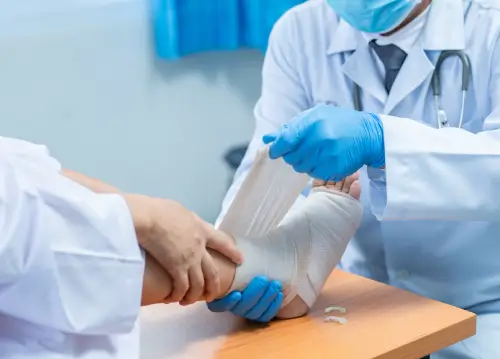
At Max Healthcare, Dr. Kuldeep Malik provides comprehensive trauma care that extends beyond the surgery. His approach combines emergency care, precise fracture fixation, and a rehabilitation strategy. The goal is steady structural repair, pain management, and a gradual return to normal activity.
Understanding Fractures and Orthopaedic Trauma
Fractures can range from simple to complex, involving joints and surrounding soft tissues. In severe instances, unstable bone fractures can cause misalignment, affect the function of a limb, or affect the functioning of a joint. To treat fractures effectively, it is necessary to evaluate the fracture, use appropriate imaging, and develop a surgical strategy based on the type and location of the fracture.
Early intervention is critical to avoid complications such as delayed healing, stiffness, deformity, or pain.
Who May Require Trauma and Fracture Care
Trauma surgery may be required for patients with:
- Recent bone fractures due to a fall or car accident
- Complex bone fractures
- Bone fractures near joints
- Unstable bone fractures that cannot heal with a cast
- Pain and limited mobility due to a bone fracture
- No improvement with medication and non-surgical treatment
Surgical fixation is required when there is a loss of stability to align the bone properly and allow it to heal.
Treatment Approach
Dr. Kuldeep Malik’s approach to trauma patients is straightforward and adaptable. In trauma situations, the first concern is to stabilise the injured limb and make sure the patient is safe. After that, comprehensive imaging and assessment guide fixation decisions.
Definitive fracture repair can be accomplished with plates, screws, rods, or external fixators, depending on the type of injury. Each technique is selected to provide optimal alignment, excellent stability, and the best possible environment for healing.
Surgical planning and anaesthesia are done with care and evidence-based best practices to improve safety and accuracy. The goal of treatment is more than simply fixing the break. It is to restore function and minimise the potential for future problems.
Key principles are:
- Accurate alignment of the fractured bones
- Stability, whether internal or external
- Preservation of soft tissues
- Early mobilisation when safe to do so